
Tech & IT
Pleasure Finder the first ever sexual education Google Assistant
“Just like you can ask Google to give you a recipe or tell you what the weather’s like, Pleasure Finder will tell users all they need to know about sex, health and pleasure – and some extra guidance when it comes to ensuring users and their partners both find pleasure in the bedroom.”

”Hey Google, how do I improve my sex life?”
Pleasure Finder – the first ever sexual education Google Assistant
MysteryVibe goes beyond the vibrator and introduces Pleasure Finder, world’s first Google Assistant action dedicated to helping people improve their sex lives, is now live for users to install on their phones, tablets and smart devices. The action helps users find out more about the health benefits of pleasure and open up about their sexual health – without fear of mockery or judgement.
Firing up the action is as easy as telling Google you want to talk to Pleasure Finder or structuring questions directly by prefacing them with “Ask Pleasure Finder.” It works for both smart speakers and displays, though the only benefit you get on the latter is the ability to visually read back responses.
It’s the first time a voice assistant has been able to offer advice around sexual health, sexual education and performance, and has been specifically designed to answer questions people want to ask about sexual health but are sometimes too afraid to ask their partner or a healthcare professional. The action was created with the help of Clare Bedford, a psychosexual and relationship therapist who worked with MysteryVibe’s Chief Medical Officer and world renowned urologist, Prof. Dasgupta, to ensure the action offered meaningful advice.
Just like you can ask Google to give you a recipe or tell you what the weather’s like, Pleasure Finder will tell users all they need to know about sex, health and pleasure – and some extra guidance when it comes to ensuring users and their partners both find pleasure in the bedroom.
And it couldn’t be simpler to use: users can just say to “Ok Google, let me speak to Pleasure Finder” and go from there. The action will outline all the different forms of advice and help it can offer, ensuring everyone can get the sexual wellness advice they need.
The action offers to “improve your sex life” with tips and answers to the bedroom’s biggest questions, like, “am I having enough sex?” and, “what are the health benefits of vibratory stimulation?” As such questions clarify, the app does include some “mature” content, but it’s far from pornographic. Questions are answered in an outright clinical way, without any slang, using precise medical terminology, and with no (intended) humor. That makes sense, as the action’s answers were written with the help of a both urologist and a psychosexual/relationship therapist.
In fact, the developers claim the Pleasure Finder action was “rejected outright by another leading firm,” probably implying Amazon didn’t want to deal with big scary sex questions in Alexa. (Google reached out to us following our original coverage to state that after review, the action does not violate its policies.)
“Having the Pleasure Finder accepted by Google is an absolute triumph. Giving access to anyone who wants or needs a shame-free sexual education is what this campaign is all about. We want to help people open up when it comes to talking about sexual health, so we’re hoping that the Pleasure Finder will be able to kick-start a conversation and people talking about sex and pleasure and rediscovering the benefits they offer” said Prof. Dasgupta, CMO of MysteryVibe and urologist.
“That’s the philosophy upon which MysteryVibe built their business – helping to set people free and give them a judgement-free space where they can genuinely open up about sexual health and wellbeing. After all, sex isn’t a taboo – it’s time to act like it.” Read more articles here









































Tech & IT
“Bombs and Porn” Debate Highlights Growing AI Concerns
AI data center projects across the United States are facing delays, cancellations, and growing public opposition as concerns rise over energy use, pollution, taxes, and the overall impact of artificial intelligence.

Nearly half of the data center capacity planned for 2026 has reportedly already been delayed or canceled. Local communities and lawmakers are increasingly pushing back against large AI infrastructure projects, with some states introducing restrictions on new developments.
Critics continue to question whether AI is truly improving daily life. Instead, AI tools are frequently associated with fake content, misinformation, cheating in schools, and harmful online material. Concerns also grew after reports connected a suspect in the 2025 shooting at Florida State University to extensive conversations with an AI chatbot before the attack.
The debate also includes concerns about AI being used in military and surveillance operations. AI-powered systems are increasingly being adopted by defense and government agencies, raising ethical and privacy concerns.
Environmental impact remains another major issue. Massive AI data center projects are expected to increase electricity demand significantly, with some companies planning new gas-powered infrastructure to support future expansion. Critics warn this could lead to higher emissions and additional pressure on energy grids.
Public skepticism toward AI also remains high. Recent polls show that many Americans believe AI could negatively affect jobs, education, and everyday life, while large numbers oppose building AI data centers near their communities.
Critics argue that instead of focusing on futuristic promises about “superintelligence,” tech companies and politicians should better explain the practical benefits AI is currently providing to ordinary people.
Tech & IT
Apple rolls out UK age verification with iOS 26.4 after Meta and Google child safety fines
Apple has introduced age verification for iPhone and iPad users in the UK with iOS 26.4 and iPadOS 26.4, adding a new layer of checks for accounts that require confirmation that the user is 18 or older.
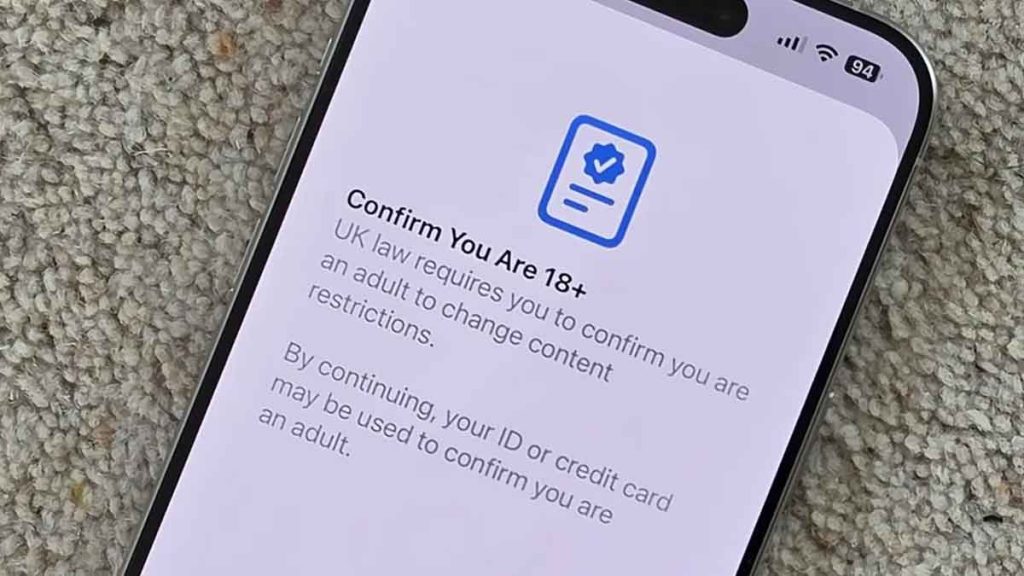
According to the report, UK users may now be asked to verify their age by adding a credit card or scanning an ID, unless Apple has already confirmed that information. Apple says the process is required by law in some countries and regions for actions tied to an Apple Account, including downloading apps, changing certain settings, or accessing specific features. When verification is needed, a prompt appears in the Settings menu.
The rollout comes at a time when child safety rules are tightening across the UK. While current UK law does not specifically require device-level age verification, adult websites, including pornography platforms, are already expected to carry out age checks. That has led to wider discussion about whether verification should also happen at the device level, rather than only on individual sites.
The timing is especially notable because it follows a major child safety case involving Meta and Google. The companies were reportedly ordered to pay $6 million after a lawsuit in Los Angeles claimed that platforms including Facebook, WhatsApp, and YouTube had a serious impact on a young woman’s mental health.
Apple’s move may also reflect broader regulatory pressure. The UK government is reportedly considering stronger restrictions for under-16s on social media, similar to measures seen in Australia. Reports also indicate Apple has been working with Ofcom as these safety tools develop.
For users who cannot verify an adult identity, Apple suggests that some features may be limited or that the account may need to be placed under Family Sharing with a parent or guardian. The exact restrictions could vary depending on the situation.
Tech & IT
Australia Age Checks Now Required for Porn Access
Australia has begun enforcing stricter age-verification rules for online adult content, requiring platforms to take meaningful steps to stop under-18s from accessing pornography and other age-restricted material. The Age-Restricted Material Codes for services including social media, relevant electronic services, equipment providers, and designated internet services came into effect on March 9, 2026.

Under the new framework, some services may now require proof of age before allowing access to legal adult content. Australia’s eSafety Commissioner says the accepted methods can vary by platform, but any age-assurance process must be accurate, reliable, and compliant with Australian privacy law. eSafety has said the changes are intended to reduce children’s exposure to pornography, high-impact violence, and other harmful age-inappropriate material online.
The rollout has already affected access to some major adult platforms in Australia, while debate continues over privacy risks and how effective the rules will be in practice. Recent reporting has also linked the changes to rising interest in VPN services as some users look for ways around the restrictions.


-

 Finance & Business8 months ago
BCAMS Magazine, the 34th issue
-

 Cam Models5 years ago
EmilyJonesChat
-

 Finance & Business9 months ago
BCAMS Magazine, the 33nd issue
-

 Finance & Business10 months ago
BCAMS Magazine, the 32nd issue
-

 Finance & Business11 months ago
BCAMS Magazine, the 31st issue
-

 Finance & Business1 year ago
BCAMS Magazine, the 30th issue
You must be logged in to post a comment Login