
Tech & IT
Age Verification on Adult Sites: Why It Doesn’t Work
This week in Texas, new regulations will demand age verification for visitors on adult websites. Although such laws aim to prevent minors from accessing inappropriate content, they may inadvertently generate larger problems.

Age Verification in Practice
Texas becomes the seventh state to tackle this age verification issue. The upcoming HB 1181 stipulates that platforms with explicit content must utilize “reasonable age-verification methods”. These can range from photos of government IDs to using transactional data to ascertain age. The legislation targets platforms where over a third of the content is considered harmful for minors.
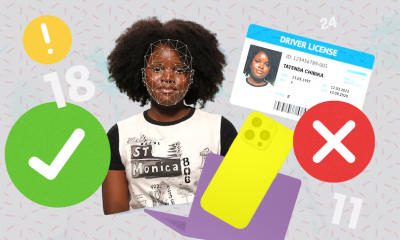
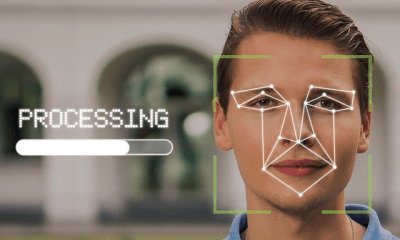
However, privacy concerns arise when such verification methods are employed. Storing personal identification information can create a lucrative target for cyberattacks. As seen in the U.K., even when third-party age verification systems are considered, issues emerge. The U.K.’s Open Rights Group has voiced concerns over certain systems that employ facial recognition, pointing out potential risks of collecting children’s biometric data without proper governance.
Australia’s Cautionary Approach
Australia has recently stepped back from implementing similar laws. While they had considered a trial of age-verification technology utilizing electronic tokens, they decided that the infrastructure for such systems required further refinement.
The Challenges of Regulation
Despite any potential verification method, both adults and minors might still find ways to access adult content without identification. Major adult websites might abide by regional laws, but numerous other platforms, especially those based in countries like Russia and China, may not. Moreover, VPNs, which can disguise a user’s actual location, further complicate regional regulations.
The U.K.’s attempt at network-level filters, proposed in 2012, was flawed. These filters failed to restrict certain explicit content while also blocking benign sites. The BCS (Chartered Institute for IT in the U.K.) suggests that governments should be cautious about solely relying on technology to address the issue. They believe the focus should be on educating the young and their guardians about online risks and mitigation, rather than purely on prevention through technology.




























Tech & IT
“Bombs and Porn” Debate Highlights Growing AI Concerns
AI data center projects across the United States are facing delays, cancellations, and growing public opposition as concerns rise over energy use, pollution, taxes, and the overall impact of artificial intelligence.

Nearly half of the data center capacity planned for 2026 has reportedly already been delayed or canceled. Local communities and lawmakers are increasingly pushing back against large AI infrastructure projects, with some states introducing restrictions on new developments.
Critics continue to question whether AI is truly improving daily life. Instead, AI tools are frequently associated with fake content, misinformation, cheating in schools, and harmful online material. Concerns also grew after reports connected a suspect in the 2025 shooting at Florida State University to extensive conversations with an AI chatbot before the attack.
The debate also includes concerns about AI being used in military and surveillance operations. AI-powered systems are increasingly being adopted by defense and government agencies, raising ethical and privacy concerns.
Environmental impact remains another major issue. Massive AI data center projects are expected to increase electricity demand significantly, with some companies planning new gas-powered infrastructure to support future expansion. Critics warn this could lead to higher emissions and additional pressure on energy grids.
Public skepticism toward AI also remains high. Recent polls show that many Americans believe AI could negatively affect jobs, education, and everyday life, while large numbers oppose building AI data centers near their communities.
Critics argue that instead of focusing on futuristic promises about “superintelligence,” tech companies and politicians should better explain the practical benefits AI is currently providing to ordinary people.
Tech & IT
Apple rolls out UK age verification with iOS 26.4 after Meta and Google child safety fines
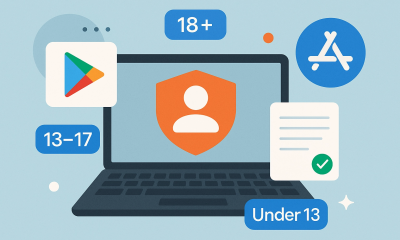
Apple has introduced age verification for iPhone and iPad users in the UK with iOS 26.4 and iPadOS 26.4, adding a new layer of checks for accounts that require confirmation that the user is 18 or older.
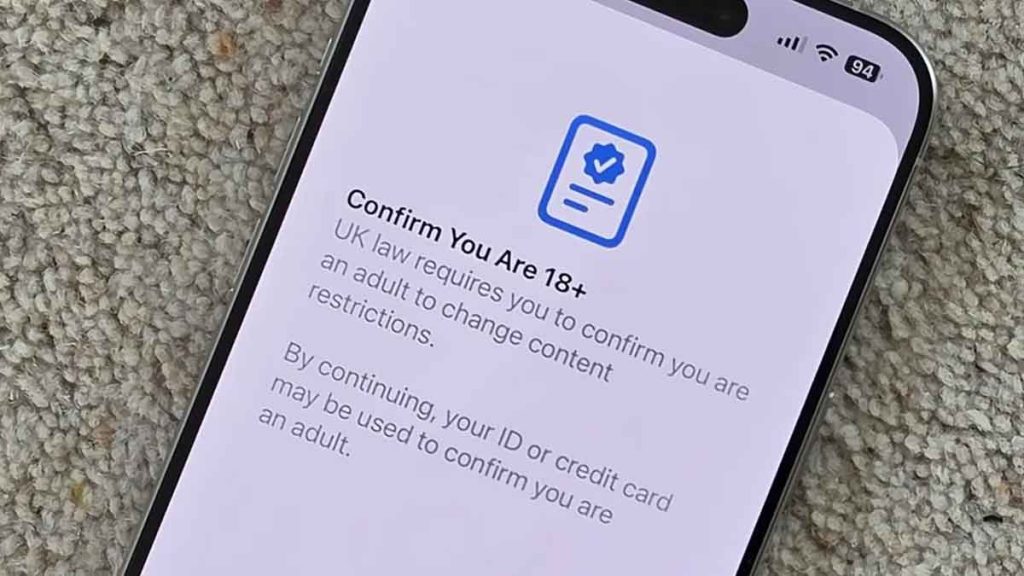
According to the report, UK users may now be asked to verify their age by adding a credit card or scanning an ID, unless Apple has already confirmed that information. Apple says the process is required by law in some countries and regions for actions tied to an Apple Account, including downloading apps, changing certain settings, or accessing specific features. When verification is needed, a prompt appears in the Settings menu.
The rollout comes at a time when child safety rules are tightening across the UK. While current UK law does not specifically require device-level age verification, adult websites, including pornography platforms, are already expected to carry out age checks. That has led to wider discussion about whether verification should also happen at the device level, rather than only on individual sites.
The timing is especially notable because it follows a major child safety case involving Meta and Google. The companies were reportedly ordered to pay $6 million after a lawsuit in Los Angeles claimed that platforms including Facebook, WhatsApp, and YouTube had a serious impact on a young woman’s mental health.
Apple’s move may also reflect broader regulatory pressure. The UK government is reportedly considering stronger restrictions for under-16s on social media, similar to measures seen in Australia. Reports also indicate Apple has been working with Ofcom as these safety tools develop.
For users who cannot verify an adult identity, Apple suggests that some features may be limited or that the account may need to be placed under Family Sharing with a parent or guardian. The exact restrictions could vary depending on the situation.
Tech & IT
Australia Age Checks Now Required for Porn Access
Australia has begun enforcing stricter age-verification rules for online adult content, requiring platforms to take meaningful steps to stop under-18s from accessing pornography and other age-restricted material. The Age-Restricted Material Codes for services including social media, relevant electronic services, equipment providers, and designated internet services came into effect on March 9, 2026.

Under the new framework, some services may now require proof of age before allowing access to legal adult content. Australia’s eSafety Commissioner says the accepted methods can vary by platform, but any age-assurance process must be accurate, reliable, and compliant with Australian privacy law. eSafety has said the changes are intended to reduce children’s exposure to pornography, high-impact violence, and other harmful age-inappropriate material online.
The rollout has already affected access to some major adult platforms in Australia, while debate continues over privacy risks and how effective the rules will be in practice. Recent reporting has also linked the changes to rising interest in VPN services as some users look for ways around the restrictions.


-

 Finance & Business8 months ago
BCAMS Magazine, the 34th issue
-

 Cam Models5 years ago
EmilyJonesChat
-

 Finance & Business9 months ago
BCAMS Magazine, the 33nd issue
-

 Finance & Business10 months ago
BCAMS Magazine, the 32nd issue
-

 Finance & Business11 months ago
BCAMS Magazine, the 31st issue
-

 Finance & Business1 year ago
BCAMS Magazine, the 30th issue
You must be logged in to post a comment Login